


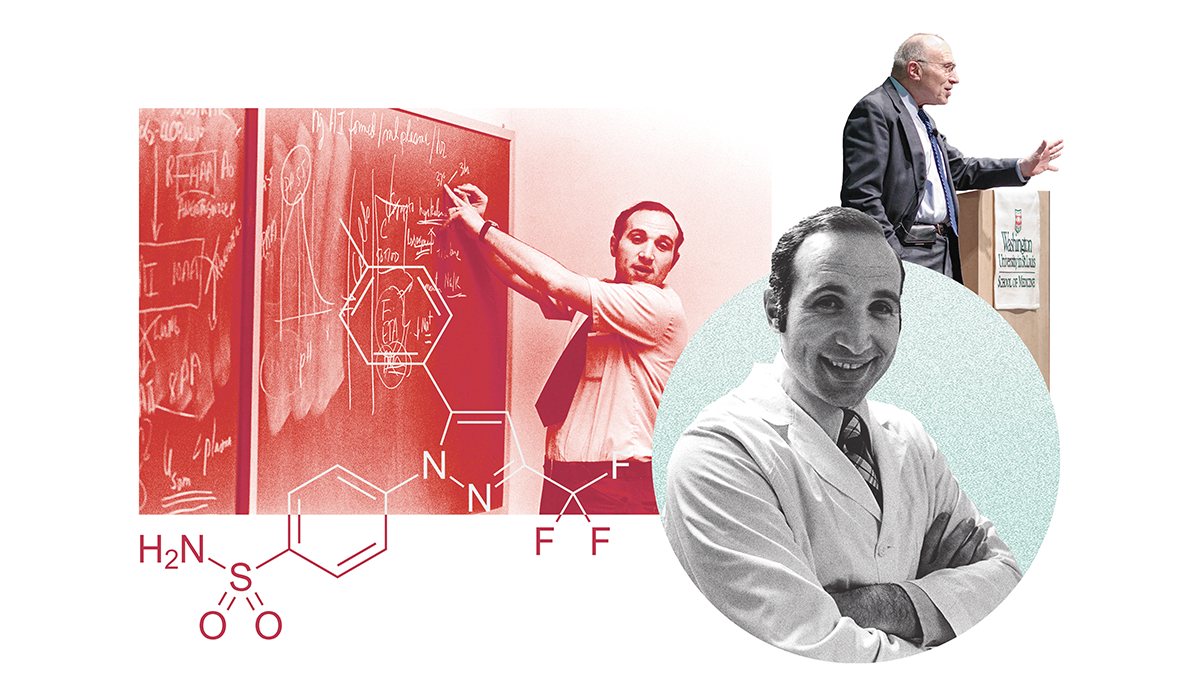
At WashU Medicine: 1967-1989; 2004-2024
Chair, Department of Pharmacology and associate dean and emeritus trustee
Phil Needleman, PhD, believed in asking bold questions and demanding meaningful results. “Define and do the killer experiments,” he urged. And if the results didn’t deliver? “Kill the program.” That clarity — and his insistence that science move faster because lives are at stake — defined a career that transformed drug discovery.
During his time at WashU Medicine, Needleman discovered an enzyme, COX-2, that plays a key role in pain and inflammation from arthritis. He also identified an inhibitor of COX-2 that showed therapeutic potential. Convinced of its clinical possibility, he left academia to lead R&D at Monsanto where he developed Celebrex — an arthritis medication that’s improved millions of lives worldwide.
Needleman understood that drug development wasn’t just about good science, it required sharp strategy, clear endpoints and discipline. His famous “10 commandments” for R&D capture that ethos: Don’t advance a drug without knowing its mechanism. If a project stalls, it’s dead. Finish what you start.
Nearly two decades later, his vision continues through the Needleman Program for Innovation and Commercialization, which helps researchers bridge the gap from the lab to clinical trials and avoid the infamous “valley of death” in translational research and drug discovery.
For Needleman, science was a calling. “The joy of the hunt of science is really the engine,” he said. “How do things work? What are the mysteries of biology?” His answers and no-nonsense wisdom continue to guide translational research and drug development today.
Published in the Autumn 2025 issue