


In an interview after he won the Nobel Prize in Chemistry in 2012, cardiologist and biochemist Robert Lefkowitz said something that I think about often. Every year, he uses the relative quiet between Christmas and New Year’s Day to review the work done in his lab during the previous year. What he doesn’t like to see during that annual review is too much success. “If we’re succeeding at too many things,” Lefkowitz said, “I’m not happy because it means we’re not asking the really important questions.”
There are so many components that go into building a successful research career and, by extension, a successful medical research program. Everyone will tell you that the most important thing is talent, and that’s true, but it’s what you do with that talent that distinguishes the truly excellent scientists and programs from the rest. The most successful programs are the ones that understand how to develop and amplify the courage necessary to tackle the tough problems and therefore do the very best science.
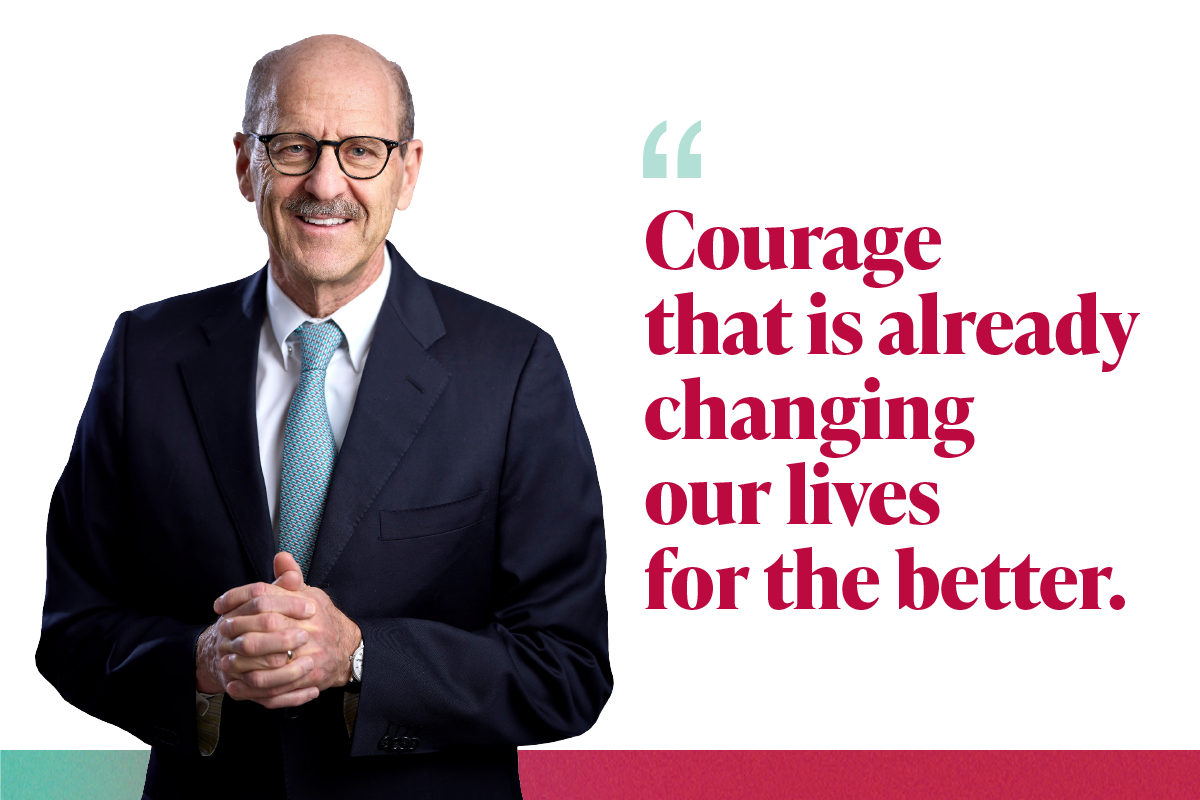
What do I mean when I talk about courage in science?
Many years ago, during my fellowship, I worked in the lab of a world-renowned investigator who put me on a project that everyone in the lab thought would fail. I think he knew that everyone thought it would fail, but I think he also understood that it would require a deep dive into cell biology, a daunting challenge for a trained clinician. And I’m sure that he deeply understood that challenge and failure are the building blocks of the courage every scientist needs to succeed. As it turns out, that assignment was the experience that launched me into my first independent lab project studying a problem I’m still in many ways, all these years later, trying to solve. Working on something so complex, with an unclear path to success, was crucial in helping me develop the courage I would need to take on the difficult objects of my own scientific obsession and to slowly build a career in medical science.
Now, decades later, it is clear to me that WashU Medicine is an incubator of just that kind of audacity. We have long been a place that supports and attracts a certain kind of doctor and scientist, the kind of person who sees big, seemingly intractable problems and just can’t wait to get to work on them. This inclination to take on the mysteries thought to be too complex and enduring to be solved is often called curiosity, or brilliance, but I really do think of it as a very particular kind of courage.
It is a form of courage that is built on experiences — I’ve done this before, and I can do it again — and by succeeding through failure. It is a courage that understands that science is, more often than not, failure; that the scientific method is, in fact, stacked against success and that those odds are actually the source of its beauty and its power. Scientists with this kind of courage know that only by slowly chipping away at a problem — and persisting despite all the setbacks — can we move scientific knowledge and human health forward. And it is this courageous persistence, a carefully cultivated patience and an ability to keep going, piece by piece, block by block, that distinguishes one scientist from another. It is what curing our most vexing diseases demands and it is the very essence of what we’ve built here at WashU Medicine, what everyone who teaches here and learns here and engages in science here has done.
What follows in the pages of this magazine is a glimpse of what can come from the cultivation of scientific courage: unbelievable discovery and hope for those suffering from devastating illnesses. These are just some of the scientists who are turning their passion for getting to the bottom of a problem or solving a mystery into remarkable progress and stunning breakthroughs.
We’re now in a moment when widespread mistrust and misunderstanding of science and the scientific method mean that this courage is more necessary than ever. And I am proud beyond words that WashU Medicine continues to invest, without compromise, in top-tier science, and particularly in the careers of the physician-scientists who bridge basic science and the development of therapies that improve the lives of patients here in St. Louis and well beyond. I hope this issue of Outlook gives you a better sense of what it means to have the courage that is already changing our lives for the better.
— David H. Perlmutter, MD, Executive Vice Chancellor for Medical Affairs, the Spencer T. and Ann W. Olin Distinguished Professor and the George and Carol Bauer Dean of WashU Medicine
Published in the Autumn 2025 issue