


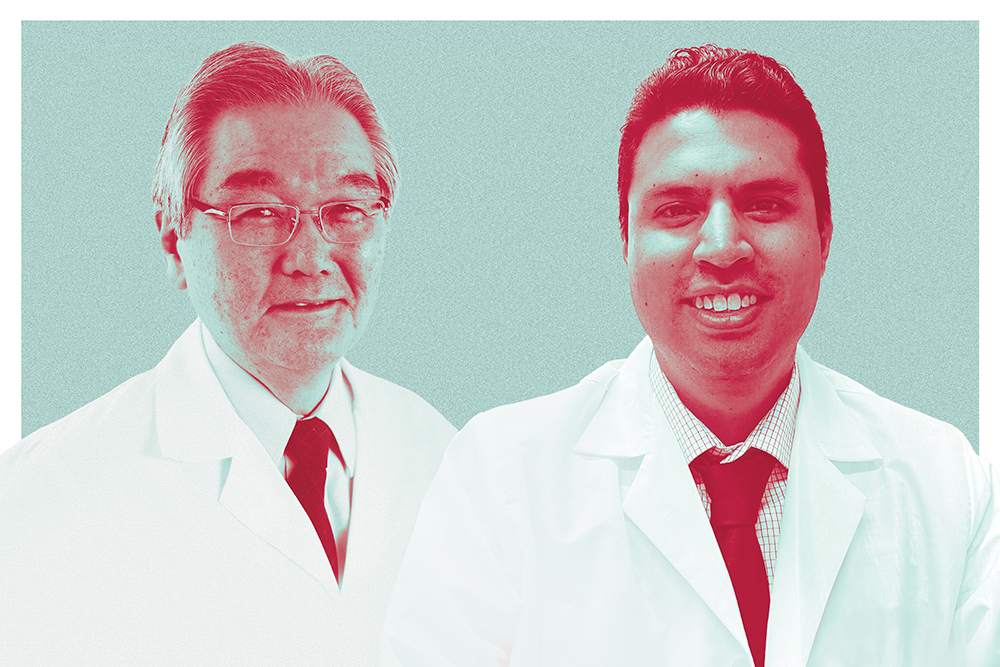
Wayne M. Yokoyama, MD, (left) and Ignacio Portales-Castillo, MD
Physician-scientists represent fewer than 2% of the physician workforce — yet their discoveries shape medicine for generations. At WashU Medicine, the Division of Physician-Scientists (DPS) is rewriting that equation. Started in 2019, DPS focuses on empowering MD-only physicians to pursue groundbreaking research while caring for patients.
For Ignacio Portales-Castillo, MD, that support has been transformative. Portales-Castillo discovered his passion for basic science as a medical trainee. Treating patients inspired him to research their illnesses on a molecular and genetic level, searching for root causes that could guide diagnosis and improve therapies.
“I wanted to become a physician-scientist, but financial constraints and family commitments prevented me from earning a PhD,” said Portales-Castillo, an assistant professor of medicine in the Division of Nephrology in the Department of Medicine.
Despite the obstacles, he didn’t lose hope. In medical school, he spent his afternoons in physiology labs observing researchers. Portales-Castillo continued seeking opportunities as an internal medicine resident at the University of Rochester in New York and as a nephrology fellow at Massachusetts General Hospital.
“I had to be self-driven because no formal pathway existed for me to become a scientist,” he said. “Until I came to WashU Medicine.”
Training MD-only physicians
A common deterrent to becoming a physician-scientist is the belief that one must earn a dual MD/PhD degree, said Wayne M. Yokoyama, MD, the division’s inaugural leader and an associate dean.
Other factors may also dissuade, including early commitment to a long training period and increasing competitiveness for smaller pools of research grants. While WashU Medicine has long had training programs for MD/PhD physician-scientists, DPS offers special programs to train MD-only physicians to overcome these factors.
“Our division expands opportunities for becoming a physician-scientist,” Yokoyama said.
Yokoyama, also the Sam J. Levin and Audrey Loew Levin Professor of Arthritis Research, continued, “This is so important because doctors may not realize their interest in lab research until after caring for a patient whose condition they want to learn more about. As physician-scientists they can examine disease from a molecular level as well as from patient perspectives, helping them to connect the dots that may lead to new therapies.”
WashU Medicine has always had an impressive roster of MD-only physicians who also conduct research, including David H. Perlmutter, MD, executive vice chancellor for medical affairs, the Spencer T. and Ann W. Olin Distinguished Professor and the George and Carol Bauer Dean of WashU Medicine. An internationally distinguished pediatric physician-scientist, Perlmutter’s research on alpha-1 antitrypsin deficiency (ATD), a genetic disorder that can lead to severe liver damage, has led to advances in understanding how cells dispose of misfolded proteins that cause cellular dysfunction.
“I was very lucky to find a great mentor, a great lab, brilliant colleagues, and a problem that needed to be solved,” said Perlmutter. “As I stand here today, 40 years later, I am still working on that same problem.” Perlmutter’s own career journey as an MD-only physician-scientist was part of the inspiration for creating the Division of Physician-Scientists.
Yokoyama — an MD-only physician-scientist internationally recognized for his research on natural killer cells in the immune system and their role in protecting the body from cancer and infections — understands the unique career pathway. “This division is here to provide support and guidance, which otherwise can be challenging — even discouraging — to find as an MD-only physician-scientist,” he said.
“One of the great things about WashU Medicine is people are often happy to share their knowledge and help those who want to learn and do more,” Yokoyama said. “This culture of mentorship and collaboration is what sets WashU Medicine apart — it’s how we turn curiosity into cures.”
Championing career success
Mentorship is a major component of the division’s competitive Dean’s Scholars Program, which started in 2020 and provides MD-only junior faculty two years of financial support and time reserved for research, as well as dedicated mentors to help guide scholars to enhance their competitiveness for research grants.
The program emerged after the medical school received a prestigious grant from the Burroughs Wellcome Fund, a nonprofit organization that supports biomedical science through research and education. WashU Medicine and individual departments also contribute significantly to the program.
This summer, the division announced its sixth class in the Dean’s Scholars Program: Quazim A. Alayo, MD; Whitney S. Brandt, MD; Roheena Panni, MD; and Portales-Castillo.
“The Dean’s Scholar award is an unbelievable opportunity,” Portales-Castillo said. “Now, I finally have the mentorship and resources to pursue discoveries that can change patients’ lives.”
Portales-Castillo’s research is influenced by his patients, such as a young woman with chronic kidney disease who also has a rare genetic condition. “I’ve developed a mouse model to study the rare disease,” said Portales-Castillo, who is earning a master of science in clinical investigation at WashU Medicine. “It’s possible my collaborators and I can soon find a way to prevent kidney failure for her and other patients with the condition.
“I think about her every day,” he said, “and this gives me an extra push to keep doing the research and continue on the physician-scientist pathway.”
Across WashU Medicine, the Division of Physician-Scientists is cultivating a new generation of leaders who bridge research and care. For patients facing today’s most complex diseases, the discoveries made here offer not just answers — but hope.
Published in the Autumn 2025 issue