


At WashU Medicine: 1931-1957
Professor of biological chemistry and associate professor of research biological chemistry and pharmacology
Carl Cori, MD
At WashU Medicine: 1931-1966
Chair of the Department of Pharmacology and the Department of Biological Chemistry and Distinguished Service Professor Emeritus
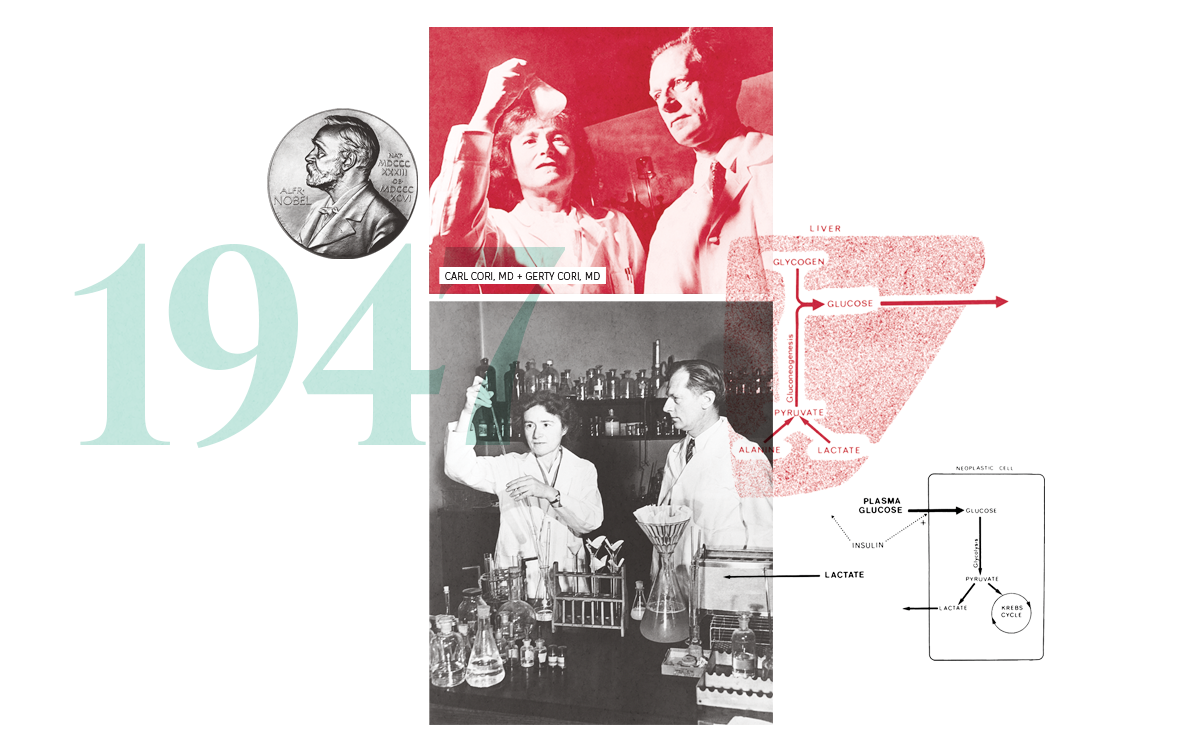
Carl Cori, MD, and Gerty Cori, MD, arrived at WashU Medicine in 1931 with a radical vision: to uncover how the body converts glycogen — its stored form of sugar — into glucose, the fuel that powers cells. Their discovery of this catalytic process, now known as the Cori Cycle, earned them the Nobel Prize in Physiology or Medicine in 1947.
The Coris’ research focused on fundamental biochemistry processes — enzymology, metabolism and molecular regulation — laying the groundwork for modern biochemistry and medical science. Their influence extended far beyond the lab bench. At a time when few embraced interdisciplinary exploration or encouraged independent thinking, the Cori Lab became a crucible of scientific rigor, bold collaboration and fearless curiosity. Intellect mattered more than pedigree, precision carried more weight than reputation, and excellence was expected at every step.
Their mentorship became a legacy of its own. Six of their trainees would go on to win Nobel Prizes. Many more became leaders who transformed fields across science and medicine. “At the end of World War II, St. Louis was the mecca for biochemical research,” said former WashU Chancellor William Danforth, MD, who trained under Carl Cori. “There weren’t any comparable labs — not in Europe, not in the U.S., not in Asia.”
Through their visionary leadership and a deep commitment to mentorship, the Coris built something much bigger than a lab. They built a movement — one that continues to shape discovery and medicine today.
Published in the Autumn 2025 issue