


Twenty deans. One enduring mission. And the man ready to carry it into the future.
Every dean of the medical school has had to master the same balancing act — moving back and forth between microscopic detail and sweeping vision; traveling from lab to bedside to podium; respecting tradition while implementing transformation; creating collaborative partnerships internally and meaningful impact in the community, the nation and the world.
As Bruce D. Levy, MD, begins his tenure as Executive Vice Chancellor for Medical Affairs and the George and Carol Bauer Dean of WashU Medicine, the job could be overwhelming — if he didn’t have 20 predecessors lighting the way.
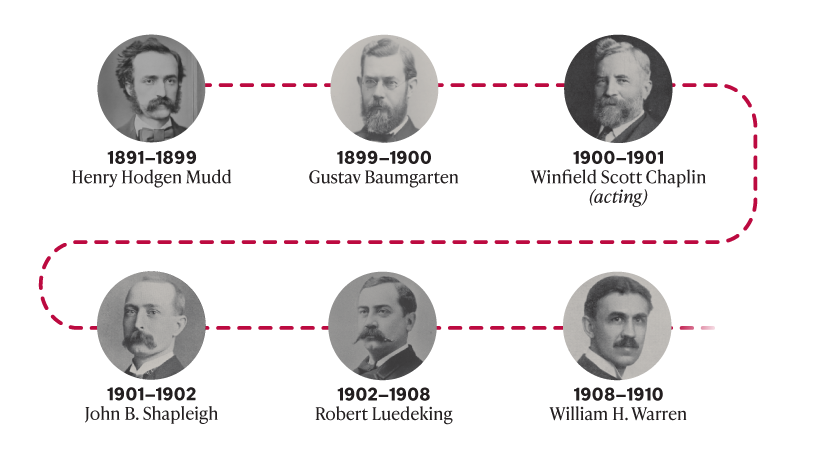
In 1891, Henry Hodgen Mudd set the tone. His surgical work was said to be more extensive than any in the West. Realizing that the nation’s young medical schools needed more resources and stability, Mudd championed the idea that St. Louis Medical College and Missouri Medical College become part of Washington University as the Medical Department.
In 1910, philanthropist Robert Brookings set out to turn the Medical Department into a world-class modern medical school. The core full-time faculty he hired included three future deans. The first was George Dock. With other med schools still relying on lectures and apprenticeships, Dock emphasized laboratory science, pathology and research-based medicine. He even persuaded WashU Medicine physicians to trade their black frock coats for the white canvas coats of lab scientists.
His successor, pathologist Eugene Opie, continued Dock’s emphasis on rigorous science, making WashU Medicine comparable to the leading schools in the world. He said a nation’s strength depended on its recognition “of the value of science and its application to the routine of living.” For clinical care, he integrated the medical school with Barnes Hospital, and he paid close attention to the atmosphere in both labs and wards. When World War I broke out, Opie served as a medical corps officer in the hospital unit formed at WashU Medicine.
Next came Philip Shaffer, the third and youngest of Brookings’ recruits to serve as dean. He, in turn, had a knack for recruiting talented young faculty members, and during his tenure, the first women students were admitted. One of the nation’s top biological chemists, Shaffer was equally interested in clinical care, saying at a 1941 convocation: “Without health and vigor there cannot be that measure of individual satisfaction and national efficiency upon which survival will depend.” Like Opie, he served during World War I. Soon after, he stepped down as dean, then reassumed the deanship in 1937 — and found himself guiding the school through another world war. Along with a crew of brilliant young department heads, he added Carl and Gerty Cori to the faculty. In 1947, they would win the Nobel Prize in Physiology or Medicine.
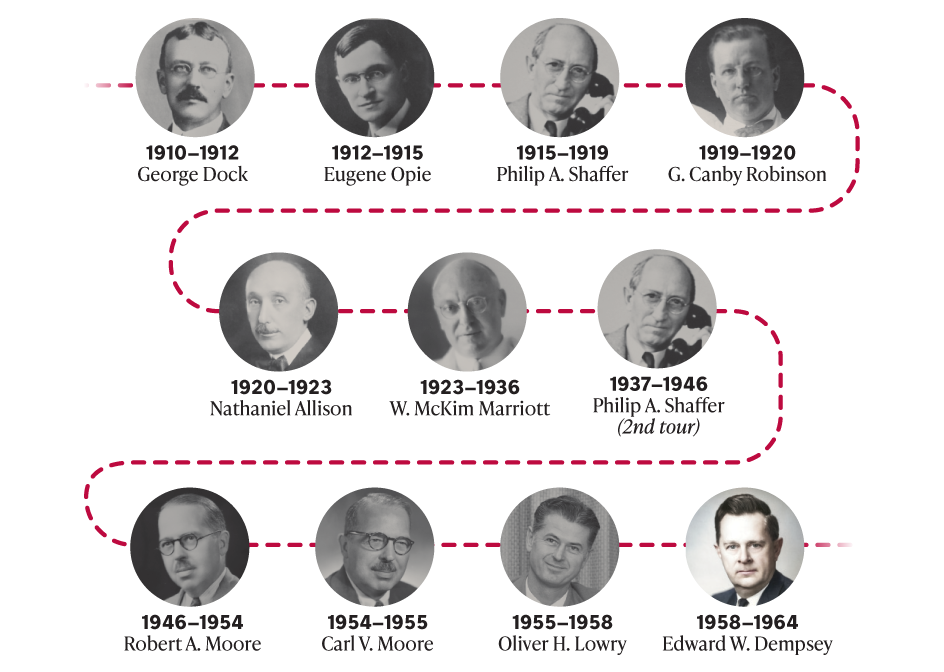
It wasn’t until 1964 when the medical school hired its first full-time dean — Ken King. Under his leadership, the campus experienced a period of significant growth with the building of the McDonnell Medical Sciences Building, Clinical Sciences Research Building and Bernard Becker Medical Library. He also led personnel searches that reshaped the executive faculty. By now, Black physicians had joined the attending staff, and the school was admitting Black students. But King pushed hard for more. William H. Danforth, MD, vice chancellor for medical affairs and president of the WashU Medical Center, described King’s tenure as “a golden age” — a time of unprecedented growth, stability and harmony.
The next dean, William Peck, continued to push the institution forward. With his leadership, the faculty grew by nearly 50 percent and WashU Medicine increased federal research funding and made breakthroughs in genetics, neurodegenerative diseases and basic sciences. Peck also oversaw the creation of the Center for Advanced Medicine, making outpatient surgeries and treatments far more available, as well as the Alvin J. Siteman Cancer Center, soon one of the nation’s leading National Cancer Institute-designated comprehensive cancer centers. He started the faculty practice plan that is now WashU Medicine Physicians, and he managed logistics as Barnes Hospital and Jewish Hospital merged, and five hospitals joined together in what is now BJC HealthCare.
In 2003, Larry Shapiro, an internationally renowned research geneticist and pediatrician, accepted the deanship. Over the next 13 years, he oversaw the expansion of the McDonnell Genome Institute and helped establish the BioMed 21 initiative, pulling disciplines together to speed the translation of lab research into clinical treatments. Along with WashU’s pivotal role in the Cortex Innovation District, BioMed 21 bolstered St. Louis’ standing as a biotech hub. Soon the WashU Institute of Clinical and Translational Sciences was established, formalizing and expanding the initiative. Eager to put health and wellness within reach of all St. Louisans, Shapiro also advocated for a new Institute for Public Health. Chancellor Mark Wrighton dubbed him “St. Louis’ physician-in-chief.”
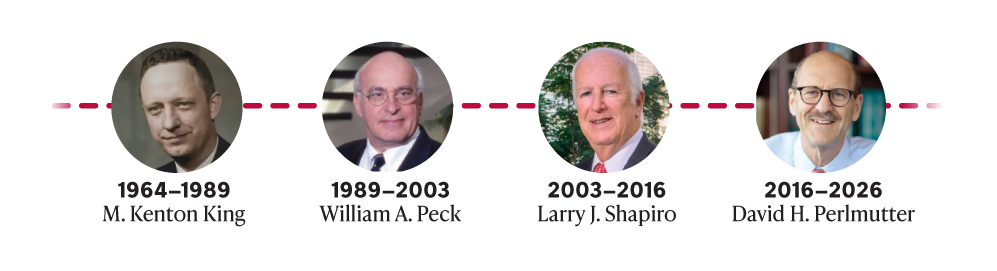
The most recent dean, David Perlmutter, strengthened WashU Medicine’s national leadership in neuroscience, cancer, precision medicine and translational research. He negotiated corporate partnerships to speed drug development. And with his leadership, the med school curriculum was transformed, and scholarship support was expanded thanks to his allocation of $100 million for MD student scholarships and curriculum renewal.
With Perlmutter’s guidance, WashU Medicine rose to No. 2 among U.S. medical schools in research funding from the National Institutes of Health (NIH) and clinical care stretched outward, making access easier even in underserved communities. The Jeffrey T. Fort Neuroscience Research Building — one of the largest facilities in the world devoted exclusively to neuroscience research — rose tall, as did a six-story addition to the Steven & Susan Lipstein BJC Institute of Health, Barnes-Jewish Hospital’s Plaza West Tower for heart and vascular care and the building of the state-of-the-art outpatient Gary C. Werths Building at Siteman Cancer Center. Plus, a new 45-year partnership was forged with BJC HealthCare. He also focused on expanding faculty leadership, appointing more women and people of color as department heads and endowed professors.
Looking forward to a promising future
Perlmutter identified a “generative restlessness” at WashU Medicine, a relentless push for excellence.
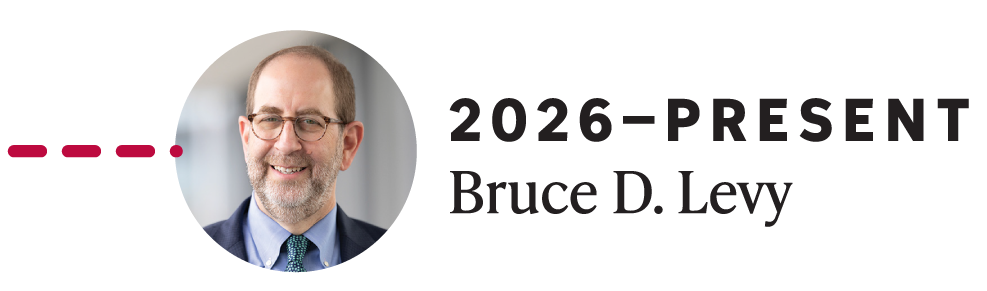
Levy, who became the 21st dean on July 1, 2026, first sensed that culture of excellence as a boy. Both of his parents had graduated from WashU. His mother went on to work as an electron microscopist at the med school, and his father as a hematologist and oncologist at what was then Jewish Hospital. As a teenager, Levy worked in WashU cell biology and pulmonology labs. He went on to attain board certification in internal medicine, critical care medicine and pulmonary disease. His research uncovered the body’s own healing mechanism in resolving lung inflammation. He has 10 patents and a novel therapeutic agent in development.
Levy now leads one of the nation’s premier academic medical institutions at a critically important time. But many of his predecessors could have said the same. Welcoming Levy, exiting board chair Andy Bursky explained that he was chosen for “scientific depth, outstanding leadership, sharp instincts and vision, and the heart to understand and explain what makes WashU special.” Only a few months into his tenure, Levy can already see what sets WashU Medicine apart, and how its incredible leadership, faculty and staff can deepen its impact in the years to come. It’s fair to say that the medical campus is looking back at more than a century of vision, wisdom, experimentation and experience — and forward to a promising future.
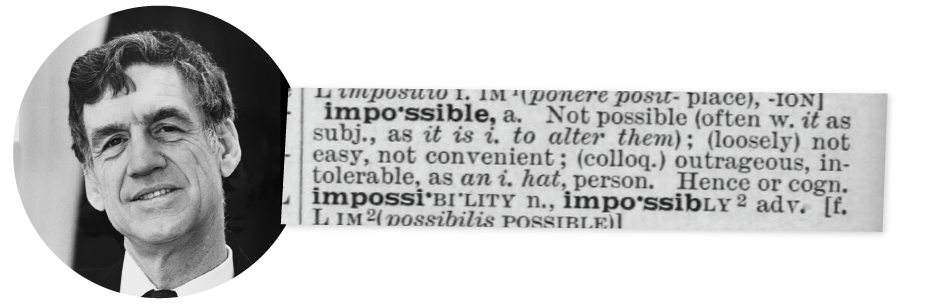
1965-1971
William H. Danforth
Before becoming chancellor of WashU in 1971, William H. Danforth, MD, was one of the many trainees transformed by working in the Cori Lab. “That’s where I learned about science,” he said. In 1965, at the age of 39, he became vice chancellor for medical affairs and president of the WashU Medical Center — a position created to further unify the med school and Barnes Hospital. It was a lesson early in life that had shaped his leadership style: when he was 12, his grandfather had told him to cut — literally, with scissors — the word “impossible” out of the dictionary. Danforth worked closely with Dean King to help weather the radical 1960s and was instrumental in the Medical Center’s expansion and redevelopment efforts.
Published in the Autumn 2026 issue