


At WashU Medicine: 2011-present
The Phil and Sima Needleman Distinguished Professor of Developmental Biology
Alzheimer’s. Huntington’s. Brain diseases that steal memories, identities and lives, affecting millions worldwide. Andrew S. Yoo, PhD, isn’t simply studying them — he’s rewriting what we know about the aging brain and opening the door to treatments once thought impossible.
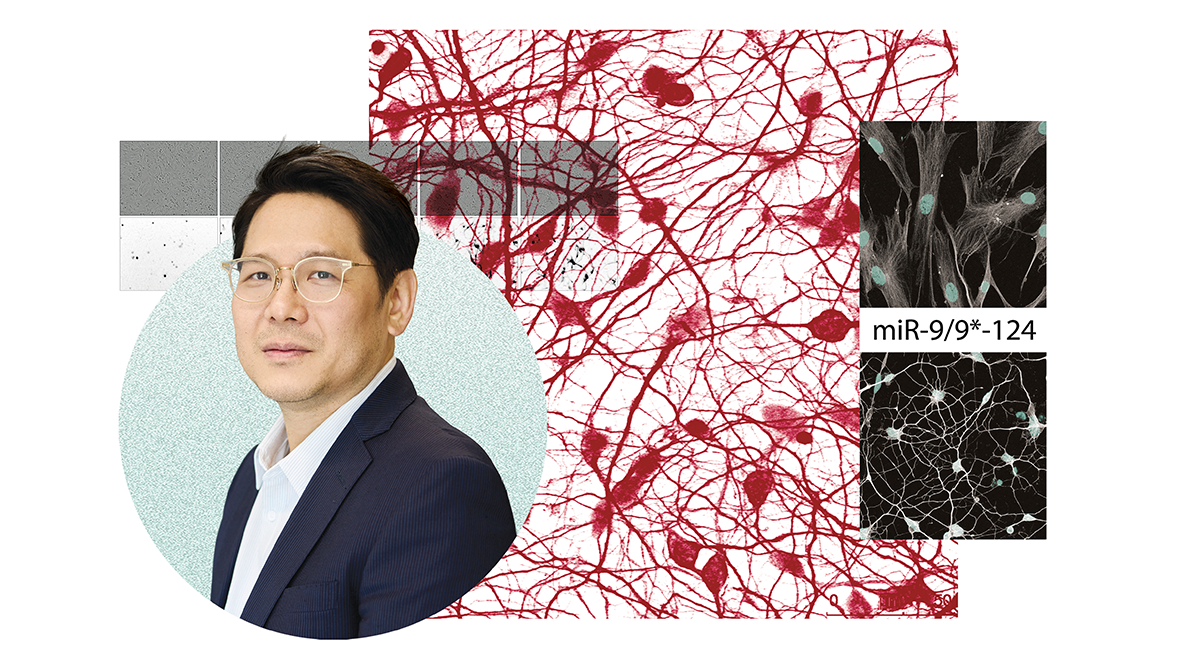
Yoo’s lab discovered how to use tiny molecules called microRNAs to reprogram human skin cells directly into neurons — the brain cells that carry our thoughts, control behavior and store memories. These lab-grown neurons retain the marks of aging and disease from the originating skin cells, giving researchers an unprecedented window into the human brain and a pioneering way to study neurological disorders in age-relevant neurons without needing brain tissue.
Using this model, Yoo’s team revealed how the brain’s cellular housekeeping system, known as autophagy, falters with age. This failure leaves neurons vulnerable to toxic buildup and eventual cell death — the underlying mechanism of neurodegeneration. Encouragingly, they’ve shown that boosting autophagy can protect brain cells, pointing toward therapies that could slow or prevent decline.
In 2024, Yoo and staff scientist Zhao Sun, PhD, unveiled their innovation, providing researchers a powerful new tool for studying Alzheimer’s disease. Their groundbreaking paper, published in Science, demonstrated that their method could reproduce the hallmarks of late-onset Alzheimer’s in lab-grown neurons, including degeneration of neurons, amyloid plaques and tau tangles. “We look forward to using this model system as we work toward new personalized therapeutic interventions,” Yoo said.
Driven by curiosity and a willingness to challenge convention, Yoo is forging a new path — for his lab and the field of developmental biology — reshaping how we understand and treat the diseases of aging.
Published in the Autumn 2025 issue