


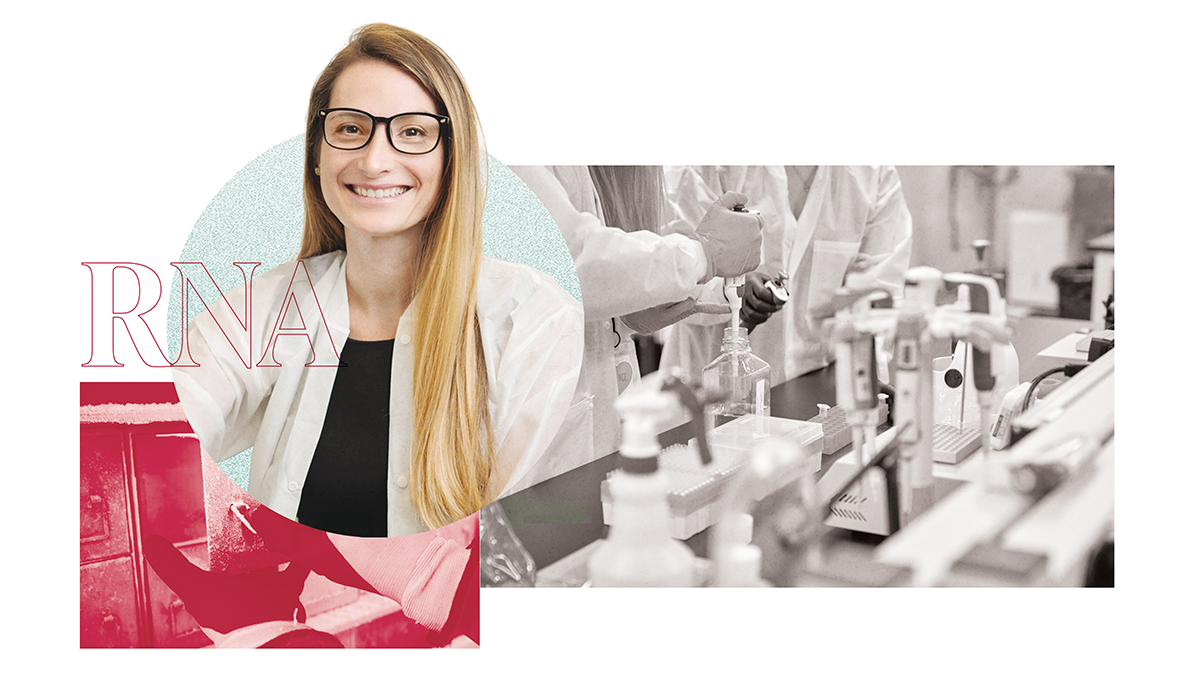
Medical Scientist Training Program Class of 2023
Co-founder and chief medical and science officer of Geneoscopy
During her first year as a student at WashU Medicine, Erica Barnell, MD, PhD, met a patient whose story would change the course of her career. The 52-year-old woman, diagnosed with late-stage colorectal cancer, explained that she’d never been screened — she simply couldn’t take the time off work for a colonoscopy.
Barnell recognized a critical gap: colonoscopy, while highly effective, is burdensome, requiring preparation and recovery time that many patients cannot easily manage. Determined to find a better way, she co-founded Geneoscopy in 2015 with her brother, Andrew Barnell, who serves as the company’s chief executive officer.
Their solution became ColoSense®, the first FDA-approved, noninvasive colorectal cancer screening home test that detects signs of cancer from RNA, molecules in our cells that indicate which genes are active. By analyzing RNA in stool samples, ColoSense detects cancer and precancerous lesions with unprecedented accuracy, including 100% sensitivity — meaning it identified all five cancer cases — in over 2,000 patients aged 45-49, a group seeing the steepest rise in colorectal cancer incidence.
Barnell’s leadership helped turn a clinical insight into an accessible, nationwide diagnostic tool. She guided the development, patenting and FDA approval process, while completing her PhD in molecular genetics and genomics.
Barnell credits the Medical Scientist Training Program at WashU Medicine and St. Louis’ entrepreneurial ecosystem for enabling her path from student to founder. “Detecting precancerous lesions in younger patients is where ColoSense can provide the biggest benefit,” she says.
Her work exemplifies how patient-centered innovation can transform the way gastrointestinal diseases are prevented, detected and treated — bringing lifesaving screening to millions worldwide.
Published in the Autumn 2025 issue