


For 25 years, WashU Medicine’s Physician-Scientist Training Program (PSTP) has launched the careers of leaders who are reshaping medicine. What began as a bold experiment and a first-of-its-kind program has become the national model — and a catalyst for discoveries that save lives.
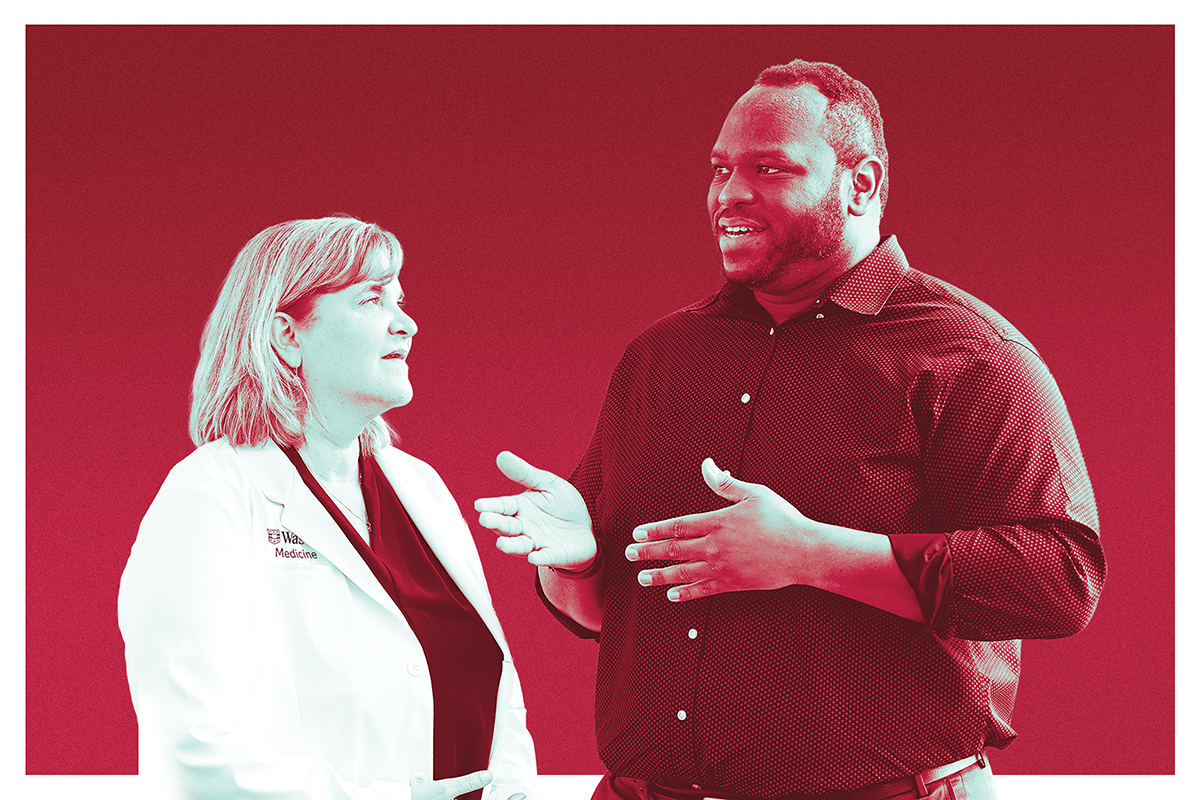
In 1998, as a freshly minted MD/PhD, Deborah J. Lenschow matched at WashU Medicine for her internal medicine residency. Soon after her arrival, her interest was piqued when she learned about the PSTP. Designed to accelerate the careers of physician-scientists, the program gave her the freedom to follow both her passions — and ultimately transform her path.
Guided by mentors Wayne M. Yokoyama, MD, and John Atkinson, MD, Lenschow discovered her calling in rheumatology. “They encouraged me to think about the patients who ’stayed with me’ long after my shift was through,” Lenschow recalled. “For me, it was always my rheumatology patients. Having two amazing physician-scientists as my clinical mentors really pushed me to follow my heart.”
Although Lenschow could have also opted for a rheumatology lab for her fellowship, she pursued a lab and mentor in pathology instead. The PSTP is designed to guarantee a fellowship in a lab of each trainee’s choosing, and Lenschow’s decision enabled her to integrate her cellular immunology background with viral immunology. This combined know-how has unlocked new insights into autoimmune disease, helping chart paths toward better treatments for patients worldwide.
The late Stuart A. Kornfeld, MD, the David C. and Betty Farrell Distinguished Professor Emeritus of Medicine, launched the PSTP 25 years ago to help curious, driven physician-scientists at WashU Medicine navigate the next steps of their career ambitions. The PSTP model has since been adopted by more than 30 medical schools across the United States.
“Stuart’s amazing vision when he put the PSTP together has really allowed it to succeed, and it’s still going strong,” Lenschow said. “I’m grateful to him and the many mentors who walked alongside me throughout my training and sent my research trajectory in a new, exciting direction.”
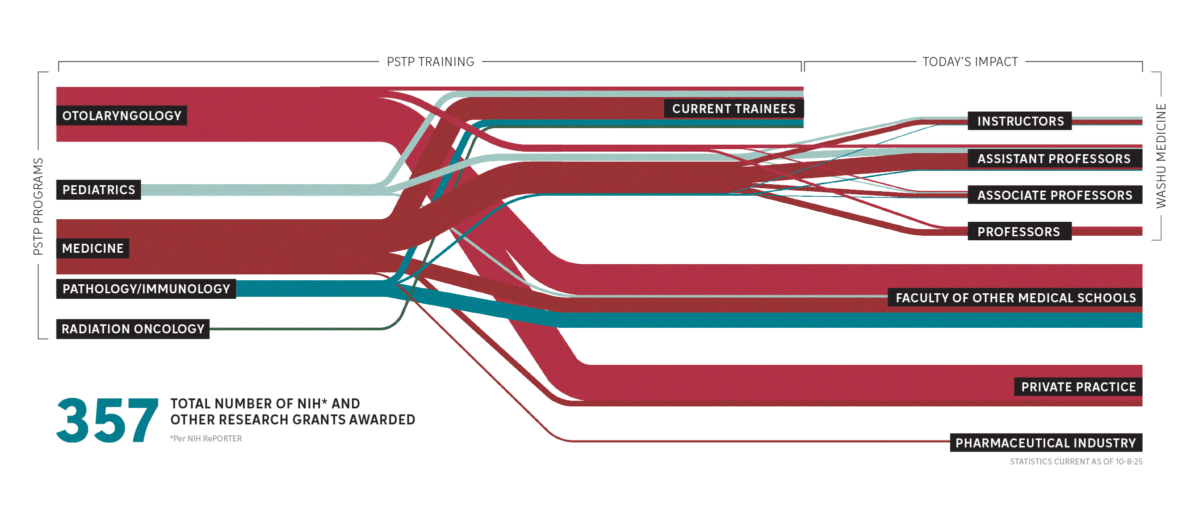
Today, the PSTP fuels lifesaving discoveries, attracts millions in research funding, and trains physician-scientists who change the way patients are diagnosed and treated. The more than 260 graduates who have gone on to become faculty at WashU Medicine and other medical schools stand as a testament to its success. Another 215 alumni now work in private practice or the pharmaceutical industry. In the decades since its inception, the PSTP has not only shaped careers — it has helped shape medicine itself.
Where trainees become trailblazers
Fast forward to 2025: Lenschow is now a professor of medicine and the John S. Daniels Professor in Immunology. She runs her own lab, mentors countless trainees and attends to rheumatology patients. She also pays it forward, empowering the next generation of trainees as co-director of the Oliver Langenberg PSTP for Internal Medicine. From hundreds of the nation’s top physician-scientists, only seven are chosen each year — underscoring the program’s prestige and the caliber of its future leaders. Lenschow and codirector Timothy J. Ley, MD, the Lewis T. and Rosalind B. Apple Professor of Medicine and a professor of genetics, have the tough task of deciding on the seven standouts.
Derek J. Platt, MD, PhD, was one such candidate who is now in his first year of the PSTP for Internal Medicine/Gastroenterology. Platt’s residency and forthcoming fellowship will prepare him to lead a lab of his own someday, where he endeavors to explore autoimmunity within the context of the gut, especially inflammatory bowel disease. A fierce advocate for underrepresented groups, Platt also aspires to use his skills to improve access to high-quality health care for those who need it most, especially those in rural America.
“The PSTP reflects WashU Medicine’s priorities to explore the scientific underpinnings of human health and advance clinical care,” Platt said. “I know I’d miss medicine if I only pursued research, and I’d miss research if I only pursued medicine. This route allows me to explore both, while also providing me with the necessary resources and structured support to be successful.”
At WashU Medicine, this kind of dual training is in our DNA — and it’s built into every aspect of this pioneering program.
Shaping careers that shape the future of medicine
Cultivating curiosity
The PSTP model combines a compressed residency and fellowship training track with ample career development and mentorship opportunities. This structure enables physician-scientists to contribute to basic science and discovery sooner, while ensuring a firm clinical foundation. Directors, including Lenschow and Ley, shepherd trainees throughout the competitive program and assist them in selecting their postdoctoral mentor.
“Every discovery starts with curiosity,” Lenschow said. “That’s what the PSTP cultivates in our early career physician-scientists. As WashU Medicine provides our trainees the tools, the mentorship and the time to pursue the intersection of medicine and research, we generate answers to medicine’s greatest challenges.”
Since its inception, the PSTP has shaped the careers of leaders who have shaped medicine. As it grows, its impact will echo far beyond WashU Medicine — redefining what’s possible when research and patient care move forward, together.
Published in the Autumn 2025 issue