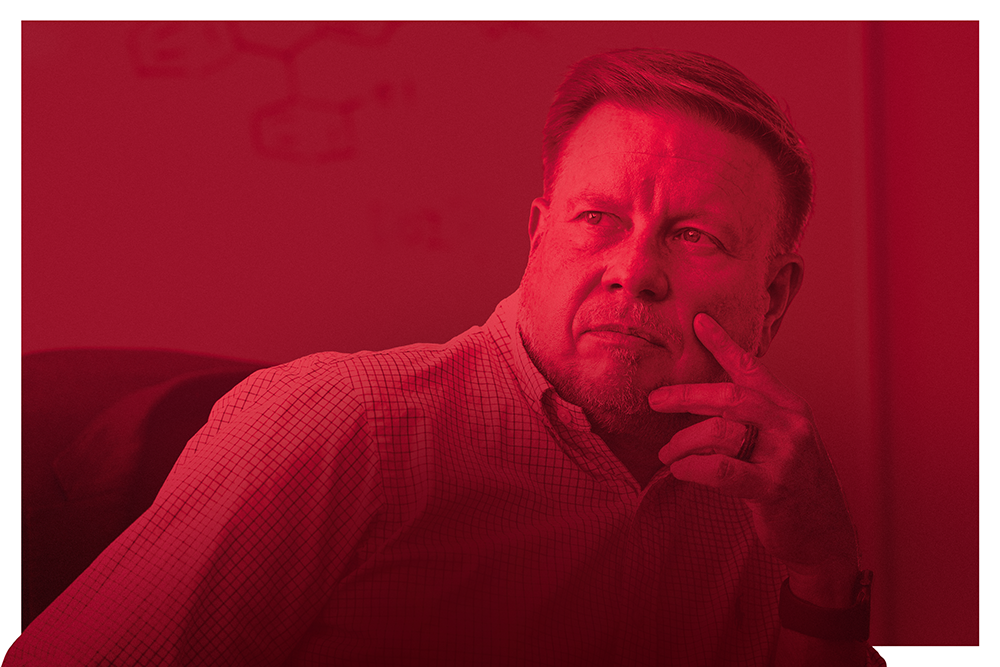
The charge on WashU’s campuses is palpable — a sense that the research happening here is not only bold but changing lives at scale. Into that current steps Doug Frantz, PhD, WashU’s new vice chancellor of innovation and commercialization. His arrival feels less like an appointment and more like a hinge moment: the instant when a great research university doubles down on building more therapies, diagnostics and devices that reach those who need it most.
Frantz brings with him a history of connecting discoveries to commercialization. He started his scientific training in East Texas and finished it with a postdoctoral fellowship in Switzerland. He came back to the U.S. to join Merck and then returned to academia to jump-start drug-development programs in the University of Texas system. This has led to his understanding of the cadence of academic inquiry and the urgency of industry development. “People here are fearless,” said Frantz. “If there is a scientific problem that needs to be solved, they will do whatever it takes to solve it. WashU is, by far, the best at tackling the toughest questions that are out there.”
WashU’s willingness to take on the toughest questions has resulted in real-world innovations with significant value to society, such as new technologies, drugs and medical devices, said Frantz. What it needs, and what Frantz has been brought here to deliver, is an accelerated pathway: Connect the right collaborators, capture the right resources and execute consistently so more discoveries travel the full distance to impact.
“It feels like it’s been my calling to develop meaningful partnerships,” said Frantz, who also is a professor in the Department of Biochemistry and Molecular Biophysics at WashU Medicine. “The opportunity to come to WashU, where the academic and intellectual resources are second to none, was irresistible.”
As an investigator with an active research lab, Frantz collaborates with scientists from the pharmaceutical industry, including with his former colleagues at Merck. It’s a common practice, and it can be a foothold to something larger, said Frantz.
“There are new ways we can work with companies and structure deals to develop scientific partnerships to fund research and innovation, and there is an eagerness here on the WashU side and with industry to come to the table,” said Frantz. He points to the recent memorandum of understanding with science and technology giant MilliporeSigma to promote research and translation efforts across WashU as an example of how collaborations with the private sector can be scaled up to support curiosity-driven science for clinical and commercial innovations.
Partnerships like that reflect a larger shift underway at WashU — one focused not simply on making discoveries, but on ensuring they reach patients and generate the resources needed to help sustain the university’s research enterprise.
“Commercialization is essential because it moves WashU’s discoveries out of our labs and into the world, where they become real diagnostics, therapies and technologies that improve health,” said David H. Perlmutter, MD, executive vice chancellor for medical affairs, the Spencer T. and Ann W. Olin Distinguished Professor and the George and Carol Bauer Dean of WashU Medicine. “In turn, the revenue generated through that process is reinvested back into the university to fuel the next generation of groundbreaking research. It creates a virtuous cycle — innovation advancing care, and that success powering even more bold science for our community, our nation and beyond.”
Shaped by industry, driven by impact
Frantz’s faith in the combined power of academic science and industry acumen was seeded long before his arrival in St. Louis. In 2000, Frantz joined Merck Research Labs. Merck had experienced a scientific transformation in the 1980s and 1990s under the leadership of then-CEO P. Roy Vagelos, MD, a former chair of Frantz’s current department at WashU Medicine, resulting in a series of breakthrough drugs. The advances continued through the later leadership of WashU Medicine Medical Scientist Training Program graduates Roger M. Perlmutter, MD, PhD, ’79, who had a senior role in the company when Frantz joined, and Joe Miletich, MD, PhD, ’79, who became senior vice president of the labs a few years later. That success was not a coincidence, says Frantz.
“Physician-scientists are the exact individuals who understand firsthand the impact they can have,” said Frantz. “They can see the direct benefit and know the unmet medical need better than researchers who might be a step removed from patients.”
Frantz left Merck determined to apply those insights to the University of Texas system, first at UT Southwestern and then UT San Antonio. He helped develop a partnership between the Simmons Cancer Center in Dallas and UT Southwestern Medical Center that led to the development of an FDA-approved drug for kidney cancers. Later, at UT San Antonio’s Department of Chemistry, he co-founded the Center for Innovative Drug Discovery — a collaboration between the university and the medical school that quickly attracted millions of dollars in government and private-sector investment.
Charting our own path to success
This is also a story about place. St. Louis has been quietly assembling the ingredients for a sustained era of biotech growth: A major academic medical center, a comprehensive health system, engineering depth, dedicated innovation districts and an increasingly engaged community of founders, operators and investors.
“We don’t need to recapitulate Boston and we don’t need to recapitulate the Bay Area,” said Frantz. “The connections within WashU, together with the variety of expertise we have here and in St. Louis, are the right mix of elements that will make growth self-perpetuating.”
“We have phenomenal people at this institution who are doing incredible science.”
— Doug Frantz, PhD
There is something profoundly local — and profoundly generous — about that vision. The therapies conceived in WashU labs are aimed at global disease burdens. Their progress will be measured in worldwide patient outcomes. Yet the act of building them, with intention, creates immediate benefits closer to home: Quality jobs, training opportunities and a reputation for excellence that draws bright minds to the region.
There is already plenty to build on. BioSTL provides lab space, training and access to capital for biotech and biomedical startups. Additionally, Cortex Innovation District, a 200-acre campus adjacent to the Washington University Medical Campus, is home to many WashU startups.
And WashU already has a vibrant startup culture, with medical faculty leading the way in areas including neurosciences, imaging and cancer. A prime example is WashU startup C2N Diagnostics, the biomedical firm that developed the first diagnostic test for Alzheimer’s disease based on discoveries from the labs of Randall J. Bateman, MD, the Charles F. and Joanne Knight Distinguished Professor of Neurology, and David M. Holtzman, MD, the Barbara Burton and Reuben M. Morriss III Distinguished Professor in the Department of Neurology. More recent is the FDA Breakthrough Device designation for an AI-powered breast cancer risk assessment software developed by Prognosia, a WashU startup founded by Graham A. Colditz, MD, PhD, the Niess-Gain Professor of Surgery, and Shu (Joy) Jiang, PhD, an associate professor of surgery. Another WashU startup, Sora Neuroscience, Inc., recently received FDA authorization to market its brain-mapping software to medical providers. Sora Neuroscience’s founder, Eric C. Leuthardt, MD, the Shi H. Huang Professor of Neurological Surgery, has joined Frantz’s team as assistant vice chancellor of innovation and commercialization.
“We have these phenomenal people at this institution who are doing incredible science and love to do what they do best,” said Frantz. “For them it is not enough to make the discovery in the lab: They are relentless in their efforts to translate our discoveries in ways that accomplish the greatest good in society, to have a tangible benefit in our hospitals and in people’s lives.”
With WashU’s fearless science as the engine and disciplined execution as the guide, the institution has built an identity that is both generous and ambitious: A community that imagines boldly and delivers with care. It is demanding and exhilarating. And it is exactly the kind of work Doug Frantz came here to lead.